

| Type of Limit | Purpose | Practical Approach |
| Daily budget | Controls spending during one day | Decide the maximum amount before playing |
| Weekly budget | Controls cumulative spending | Track all gambling spending across the week |
| Loss limit | Creates a financial stopping point | Stop when the predetermined loss amount is reached |
| Deposit limit | Restricts how much or how often money is added | Set the limit before a session |
| Session time | Controls how long one session lasts | Use a timer or reminder |
| Breaks | Interrupt continuous play | Leave the gambling screen completely |
| Account restriction | Creates a stronger barrier | Use available platform controls or contact support |
Financial Limits
A financial limit is an amount decided before gambling begins. It should be based on disposable money rather than on how much a person hopes to win.
For readers in Bangladesh, the budget can simply be planned in BDT. The important point is not the currency but whether losing the full amount would affect normal expenses.
A basic financial plan can follow three steps:
- calculate what remains after essential costs;
- choose a maximum amount from disposable funds;
- treat that figure as a hard stopping point.
The budget should not increase because the session is going badly.
Daily and Weekly Budgets
A daily limit controls spending over one day, while a weekly limit provides a wider view of repeated sessions.
For example, a person may remain within a small daily amount but still spend more than intended by gambling every day. A weekly budget makes that pattern easier to see.
Track:
- deposits made during the period;
- money already lost;
- remaining gambling budget;
- days on which gambling took place.
If the daily or weekly amount is reached, increasing it to recover a loss defeats the purpose of setting the limit.
A loss does not create a financial requirement to continue. The original budget should remain unchanged whether the session ends positively or negatively.
Separate Gambling Money From Essential Expenses
Gambling funds should be separate from money required for everyday responsibilities.
Essential money includes:
- rent or housing costs;
- food;
- electricity and other bills;
- transport;
- loan or debt repayments;
- education and family expenses;
- emergency savings.
A useful test is simple: if losing the money would create difficulty paying for something necessary, it should not be part of the gambling budget.
Borrowed money should also remain outside the budget. Credit or loans add a repayment obligation to an already uncertain activity.
Time Limits
Spending is only one part of gambling control. Time can also expand beyond what was originally intended.
Long sessions can make it harder to notice cumulative spending or recognise emotional decisions. A time limit creates a predetermined end point regardless of the outcome.
| Situation | Better Limit-Based Response |
| The session is going well | Still stop at the planned time |
| The session is going badly | Do not extend it to recover losses |
| A match or game is still running | Follow the limit rather than automatically continuing |
| You lose track of time | End the session and review the plan |
| Breaks are repeatedly skipped | Reduce session length or stop |
Plan Your Playing Time
Decide the session duration before opening a casino or sports betting platform.
A timer, alarm or calendar reminder can provide an external stopping signal. This is particularly useful because relying on “I will stop when I feel like it” leaves the decision to the same moment when excitement or frustration may be strongest.
A simple session plan is:
- select a start time;
- decide the maximum duration;
- set a timer;
- stop when it ends;
- avoid starting another session immediately.
Do not add extra time because of a loss or because one more game appears attractive.
Take Breaks Between Sessions
A break should interrupt gambling rather than simply move activity from one game to another.
During a break, leave the app or website and focus on something unrelated. This provides a chance to check both spending and emotional state.
A break can be useful for asking:
- How much have I spent?
- Am I still within my original budget?
- How long have I been playing?
- Am I trying to recover a loss?
- Am I continuing because I planned to, or because I feel unable to stop?
If the answers show that the original limits are already being ignored, the appropriate response is to end the session rather than shorten the break.
Using Gambling Controls
Personal rules can be supported by technical controls where the platform provides them.
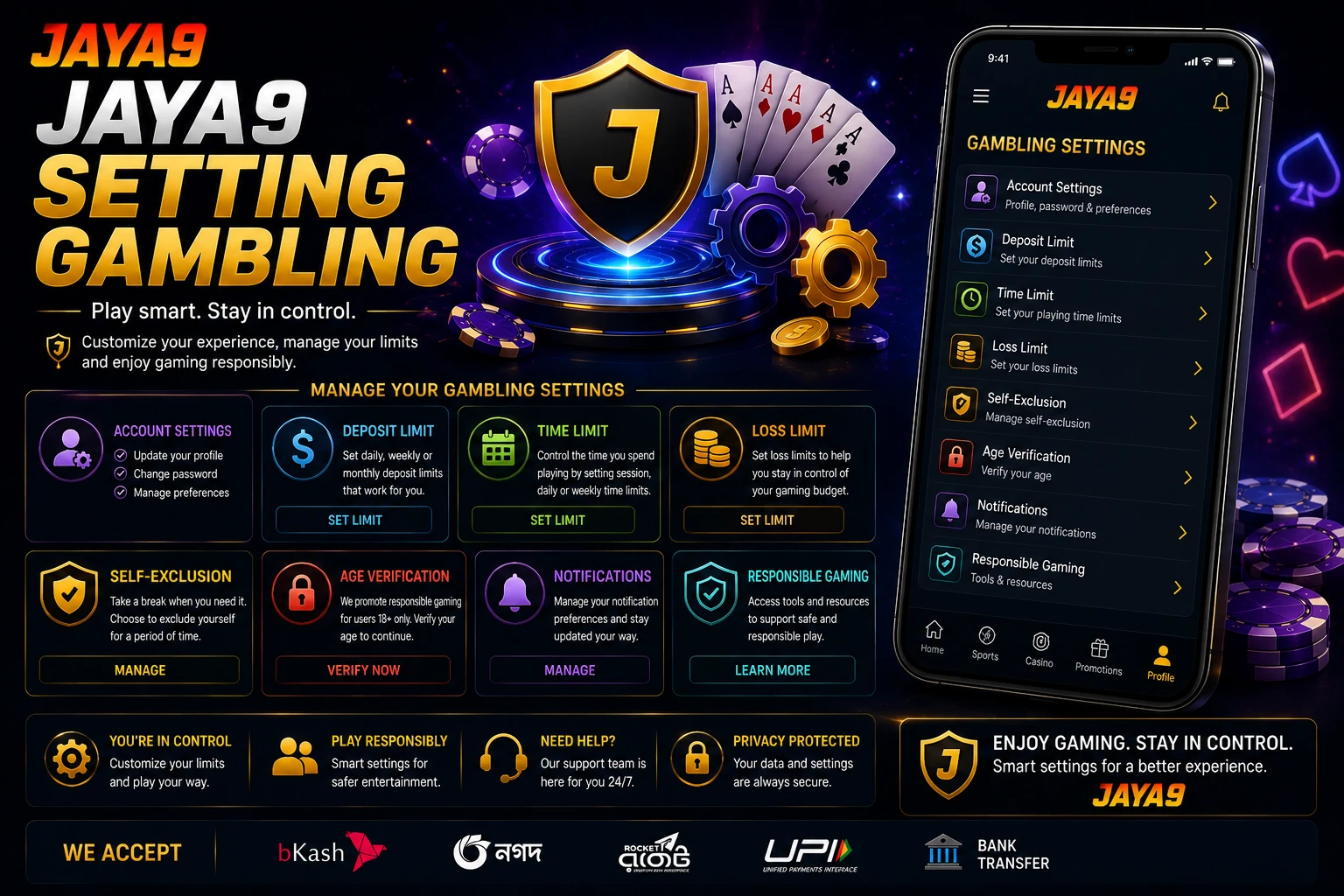
The current Jaya9 Bangladesh page states that users can set limits related to the number of deposits and the amount of losses. It does not publish fixed universal values for these limits, so users should check the current account interface for the options available to their profile.
Deposit and Spending Limits
A deposit control can create an additional barrier between an initial budget and an impulsive decision to add more money.
Jaya9’s current public information specifically refers to limits on the number of deposits and on losses.
These controls are most useful when they are set conservatively before gambling begins.
They should not be increased immediately after:
- reaching a deposit limit;
- losing more quickly than expected;
- feeling frustrated;
- deciding that another deposit could recover previous losses.
If a technical limit repeatedly feels inconvenient, that may indicate that the planned spending level is already too high rather than that the limit needs to be raised.
Time-Outs and Self-Exclusion
A time-out generally means a temporary break from gambling access. Self-exclusion usually refers to a stronger or longer restriction intended to prevent account use for a defined or extended period.
The current public Jaya9 pages do not clearly confirm a dedicated self-service Time-Out or Self-Exclusion menu. They do, however, state that customers who struggle to control their betting can contact Jaya9 for practical help, including suspension of the betting account.
Users who need that type of restriction should therefore use the currently published support route rather than assume a particular account-control button exists. Jaya9 lists customer support and Live Chat among its contact options.
Review Your Limits Regularly
Limits should be reviewed based on behaviour, not on a desire to spend more.
A useful review asks:
- Did I stay within the financial budget?
- Did I stop at the planned time?
- Did I make extra deposits after losses?
- Did I borrow or use essential money?
- Did I repeatedly ignore breaks?
- Did gambling interfere with work, sleep or other responsibilities?
- Did I feel pressure to recover money immediately?
Repeatedly breaking a limit is not a reason to increase it.
Instead, it is a signal to reduce gambling activity, take a longer break or use stronger controls. If voluntary limits no longer feel effective, account restriction or suspension can provide a clearer barrier.
The purpose of setting limits is to make decisions while thinking clearly and then follow those decisions later. A budget, time limit or account restriction only works when reaching it means stopping rather than renegotiating the rule during the session.